From idea to realized savings — an AI-augmented opportunity pipeline
For a Fortune 100 healthcare payer running a multi-billion-dollar Cost-of-Care savings mandate. Replacing document-heavy intake and ServiceNow blind spots with a connected, AI-classified opportunity lifecycle.
A doc-heavy process for a multi-billion-dollar mandate
The Problem
- Ideas scattered across email, Slack, decks, and SharePoint
- ServiceNow only tracks execution — ideation is a blind spot
- No one place to see "idea → estimated → realized" for any opportunity
- Inconsistent classification: the submitter had to guess the right team
- Annual savings target invisible at the portfolio level
- No archetype-level rollup to compare domains
The Shift
- One intake, any employee, any plain-language description
- AI agent classifies archetype and suggests priority at capture
- Five-stage ontology applied consistently across every archetype
- ServiceNow integrated as an execution step, not the system of record
- Portfolio dashboard mapped to the annual CoC target
- Action Center unifies the individual's task list across opportunities
Four personas, one shared data model
One system, four audiences — from the clinician with an idea to the VP defending the annual savings mandate. Each persona enters from a different surface; the data model underneath is the same.
Three dashboards, three audiences
The portfolio shows up differently depending on whether you're executing, curating, or reporting. Click any tile to see the full page.
Three key moments in the lifecycle
The product is broad, but three moments carry the whole story: how an idea enters the system, how the archetype ontology gives it structure, and how execution rolls up into realized impact.
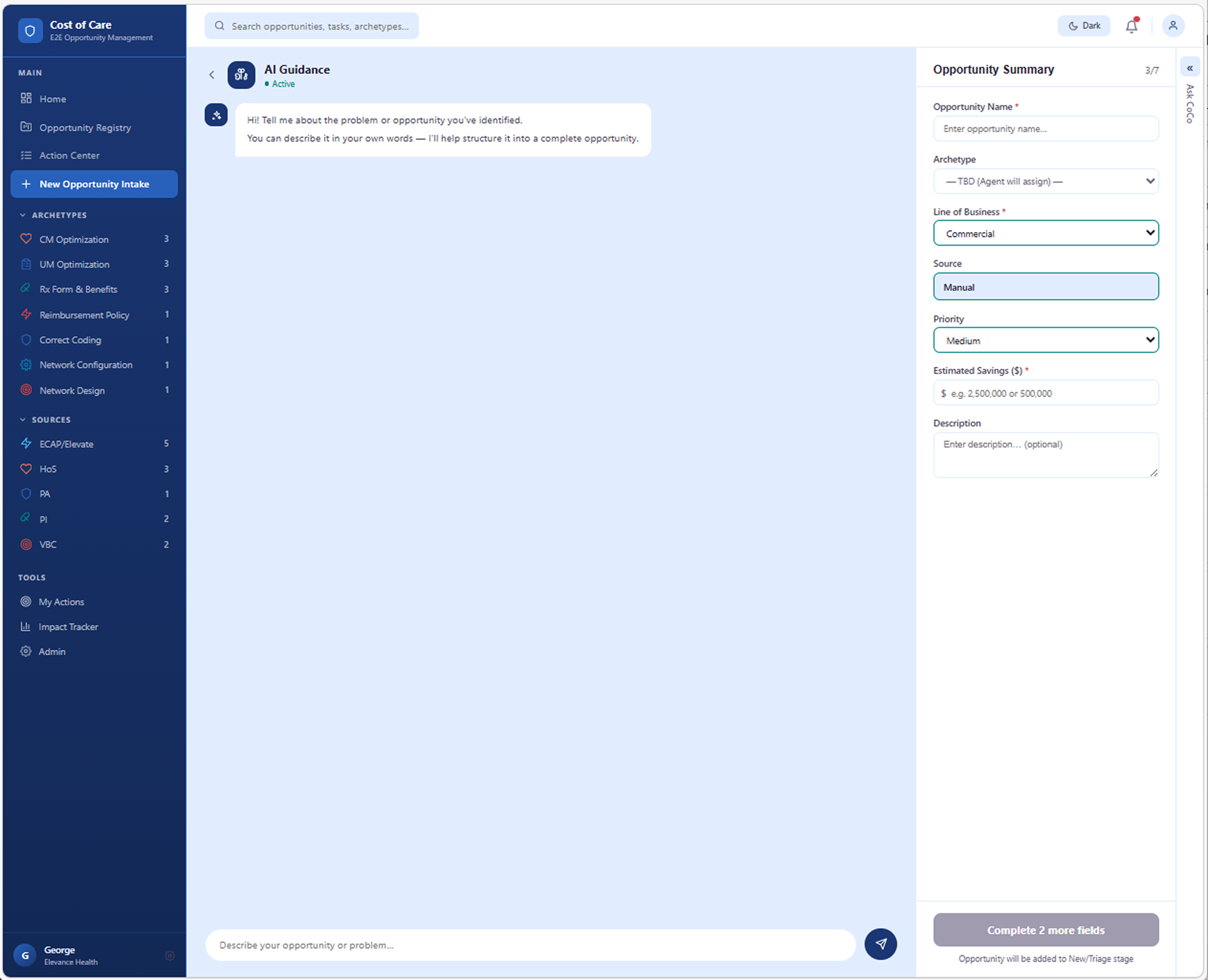
Anyone describes the idea — AI handles the structure
Intake & classificationThe submitter types the opportunity in plain words. An AI agent reads the description, auto-assigns the archetype, suggests a priority, and populates the structured fields. What was once a "where do I send this?" friction point becomes a one-minute capture.
Idea-to-realized, made legible
From doc-heavy to intelligent
AI archetype classification removes the org-chart literacy the submitter used to need. Idea in, structured opportunity out.
Pipeline visibility before SNOW
Ideation is no longer a ServiceNow blind spot. The portfolio-level view starts at "someone had an idea," not "a ticket exists."
Consistent rollup across archetypes
The same 5-stage ontology across every archetype means a VP can compare CM vs UM progress without first reconciling templates.
One surface, four audiences
Submitter captures, Owner executes, Archetype Lead curates, Program Lead reports — same product, different entry points, shared data model.
Designing an ontology, not a form
The core design challenge wasn't a form — it was an ontology. Opportunities flow through the same five stages, but the workflow steps inside each stage differ by archetype and by the team that executes it. Getting that abstraction right — general enough to roll up, specific enough to be useful — shaped every downstream decision.